Why SLS?
No support structures
Internal channels and undercuts are possible.
Very durable
Tough polyamides for real functional parts.
Small series
Many parts in one build, consistent quality.
Movable assemblies
Joints and hinges in one print.
SLS at ProtyLabs
Guide values. What is realistic for your part, we clarify in the quote.
| Feature | Value |
|---|---|
| Processes | Laser sintering of plastic powder |
| Materials | PA12, PA11, TPU (Shore 40A–90A) |
| Printed threads | from approx. M6 |
| Surface | matte, slightly rough, can be dyed |
| Quantity | Single part to series |
Materials for SLS
PA12
Strong, tough and dimensionally accurate. The all-rounder for functional parts.
PA11
Higher elongation at break, good for snap fits and clips.
TPU (Shore 40A–90A)
Rubber-like elastic – hardness selectable from soft to firm, for seals, buffers and grips.
What we use it for
How to make your part better
When another process is a better fit
SLA
When the surface must be smooth without finishing.
FDM
When a simple part is needed quickly and cheaply.
SLM (metal)
When strength or temperature go beyond plastic.
What is SLS – and when is it worthwhile?
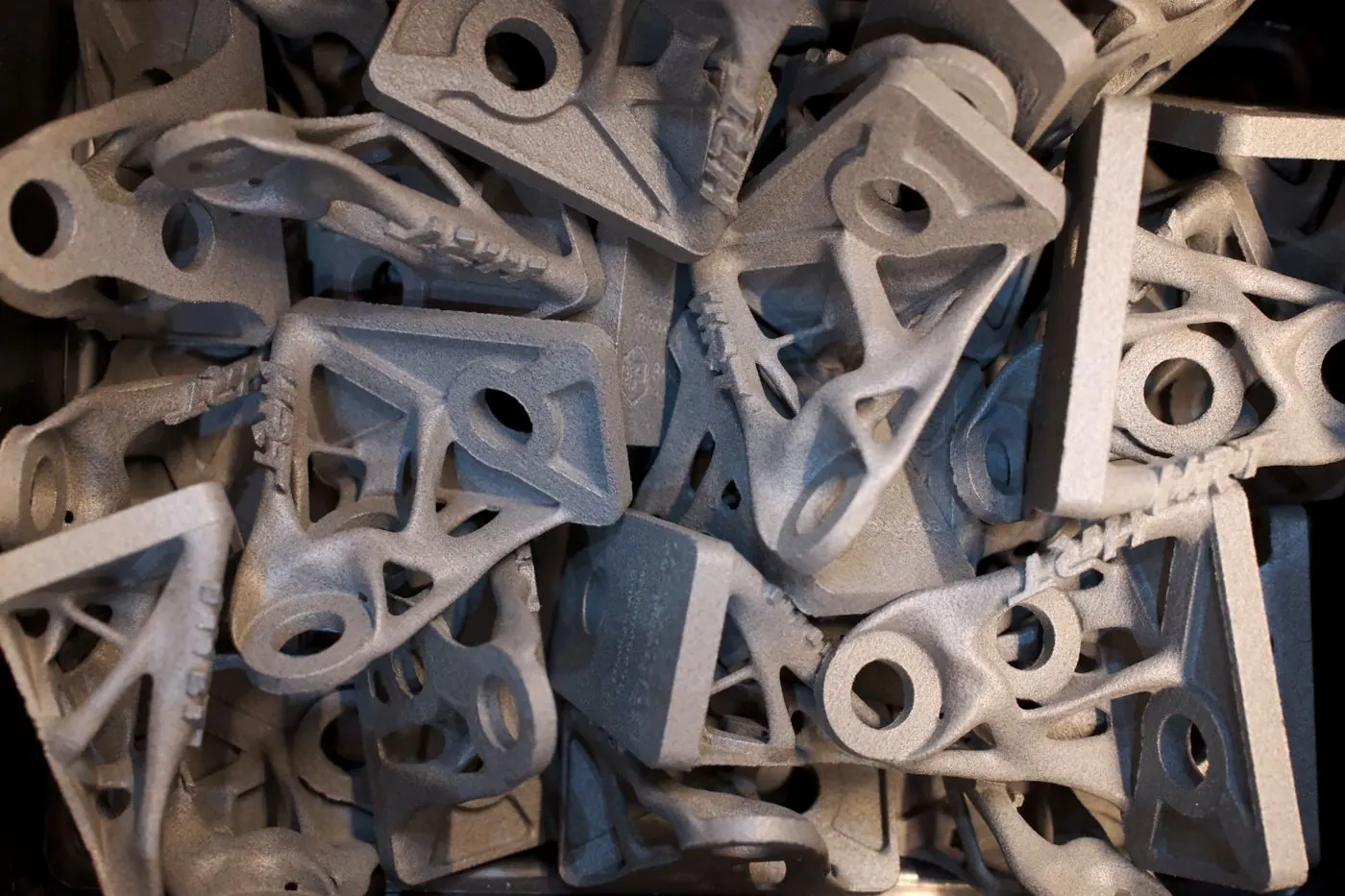
In selective laser sintering (SLS), a laser fuses fine plastic powder layer by layer. The surrounding unfused powder supports the part during printing. That is why SLS needs no support structures: undercuts, internal channels, snap fits and even movable assemblies are produced in a single run.
SLS pays off whenever a part is really loaded, has a complex shape or is needed in several copies. Because many parts fit into the powder bed at the same time, the unit price falls with quantity – ideal for small series from a single part. For very smooth visible surfaces SLA is the better choice, for simple single parts often FDM.
Typical materials are PA12 as a tough, dimensionally accurate all-rounder, PA11 with high elongation at break for clips and hinges, and TPU in Shore hardnesses from 40A to 90A for flexible parts. The surface is matte and slightly rough; it can be dyed, blasted or chemically smoothed.
Design guide values
| Materials | PA12, PA11, TPU (Shore 40A–90A) |
|---|---|
| Wall thickness | from 1.0 mm, safe from 1.5 mm |
| Clearance for moving parts | 0.3–0.5 mm laterally, 0.5–0.6 mm vertically |
| Printed threads | from approx. M6, smaller with threaded inserts |
| Support structures | none needed |
| Cavities | with openings for depowdering |
| Surface | matte, slightly rough – can be dyed and smoothed |
| Quote · delivery | within 24 h · express 2–3 days incl. shipping, standard 5 days |
Guide values. We clarify what is realistic for your part in the quote.
What drives the price
- Part volume and build height – they determine powder and print time
- Quantity: the more parts fit into one build, the cheaper each part
- Material: PA12 is the most economical, TPU and PA11 slightly more expensive
- Post-processing such as dyeing, smoothing or threaded inserts
- Lead time: express carries a surcharge
How to make your SLS part better and cheaper
- Keep wall thicknesses even – replace large solid areas with ribs
- Avoid large flat plates, they can warp
- Print moving parts in one piece with sufficient clearance
- Order several parts together – it fills the build
- Plan threaded inserts for threads that are opened often
FAQ about SLS
Can SLS parts be dyed?
Yes, the porous surface absorbs colour well. Ask us about colour options.
Are SLS parts watertight?
Not automatically. Watertight parts require post-treatment.
Is SLS worthwhile for series?
Yes, because many parts can be produced at the same time.
Want to turn your idea into a finished part?
Send us CAD data, a photo, a sketch or the original part. We check feasibility, process and material and get back to you with an assessment and a quote.